

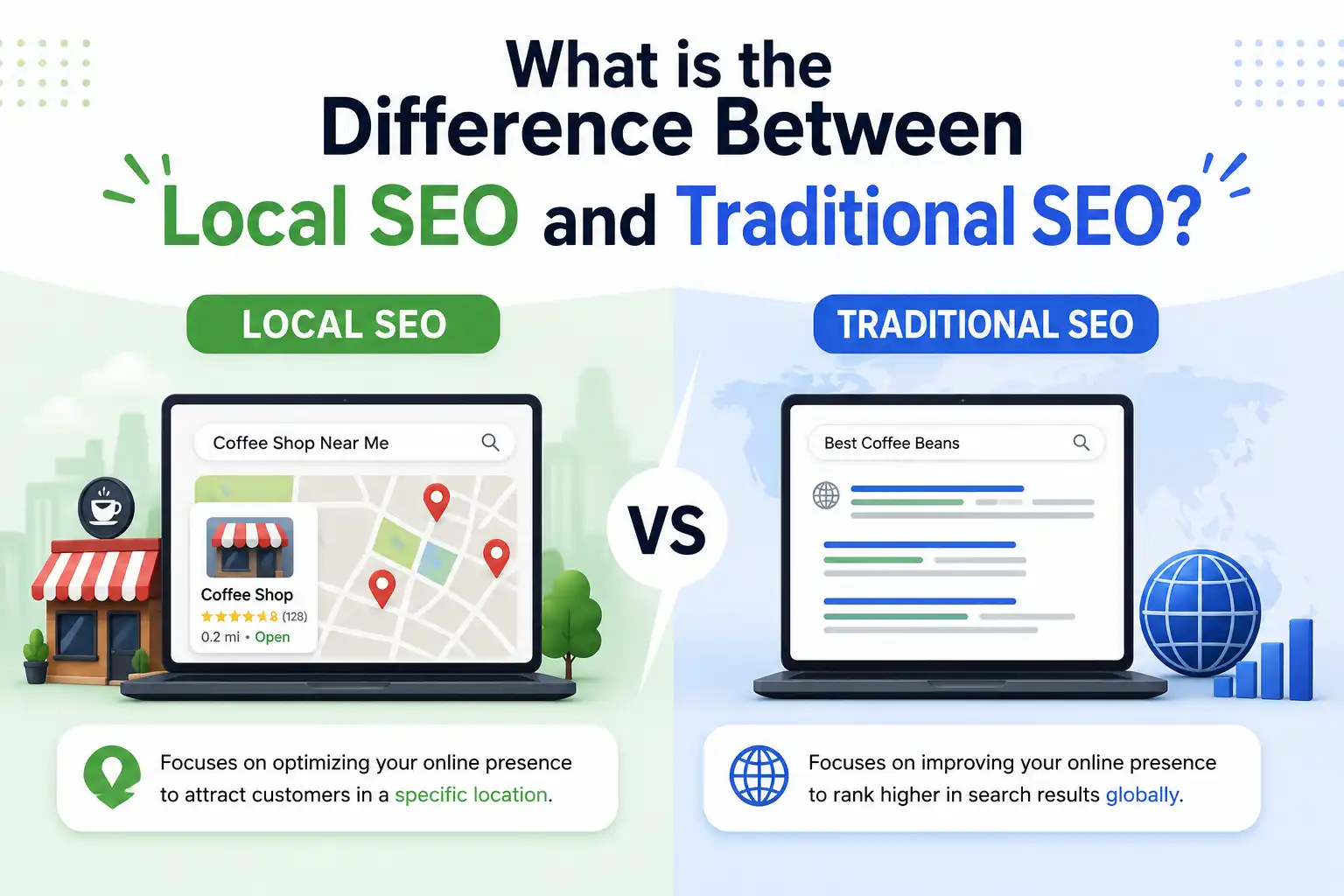
Have you ever typed “coffee shop near me” on your phone and found a café two streets away? That is local SEO doing its job. But when you searched “how to brew the perfect espresso” and found a blog post from New York, that was traditional SEO at work. Both live under the same SEO umbrella. Both matter. Yet they are built for completely different goals, audiences, and strategies.
If you are a business owner, a marketing manager, or someone who just wants to understand why your competitor keeps outranking you, finally, this guide is for you. We are going to break down every single difference, help you understand which one you need, and show you exactly how to use both to dominate search results.
At 4P Wisdom, we have helped dozens of businesses navigate this exact question. So let us get into it, no jargon, no fluff, just clarity.
What is SEO and Why Does It Even Matter?
Before we compare the two types, let us make sure we are on the same page about what SEO actually is.
SEO stands for Search Engine Optimization. It is the practice of making your website and online presence more visible on search engines like Google, Bing, and Yahoo. When someone types a query into Google, the search engine scans billions of web pages and decides which ones deserve to appear at the top.
The higher you rank, the more people see your business. The more people see your business, the more traffic, leads, and sales you generate. That is why SEO is considered one of the highest-return digital marketing investments a business can make.
According to a study by BrightEdge, organic search drives over 53% of all website traffic globally. That is more than paid ads, social media, and email combined. In other words, if you are not doing SEO, you are handing customers directly to your competitors.
Now here is where most people get confused. SEO is not just one thing. It is a broad discipline with different strategies tailored to different goals. The two most important strategies for most businesses are traditional SEO and local SEO. Understanding the difference between them will completely change how you approach your marketing.
What is Traditional SEO? A Deep Dive
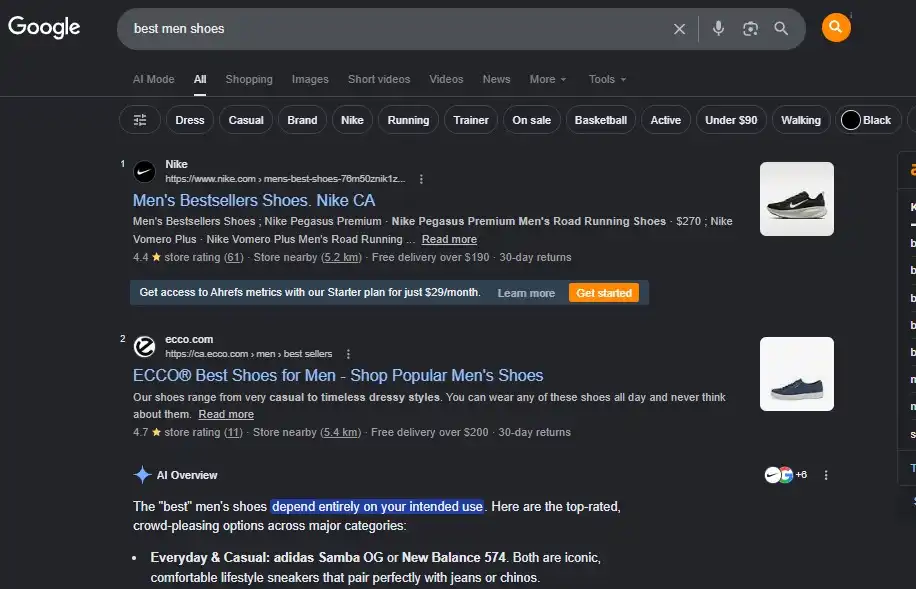
Traditional SEO, often called organic SEO, is the process of optimizing your website to rank on search engine results pages (SERPs) for broad, non-location-specific queries. The audience you are trying to reach can be anywhere in the world or across an entire country. Location is irrelevant.
Think of a software company selling project management tools. Their customers could be in Dallas, London, Toronto, or Singapore. They do not care where the buyer sits. They just want the right person, with the right problem, to find their product. That is traditional SEO in action.
Traditional SEO is built around satisfying Google’s core ranking algorithm. This algorithm evaluates hundreds of signals to decide which content deserves the top spots.
What Does Traditional SEO Actually Involve?
Traditional SEO covers three main pillars: on-page optimization, off-page optimization, and technical SEO. Here is what each one means in practical terms.
On-Page SEO involves everything you do directly on your website. This includes writing content that genuinely answers search queries, placing target keywords naturally in your headings and body text, writing compelling meta titles and descriptions, using proper heading structures from H1 to H6, optimizing image alt text, and building smart internal linking between your pages.
Off-Page SEO involves everything that happens outside your website that signals authority to Google. The biggest factor here is backlinks. When reputable websites link to your content, Google treats it as a vote of confidence. The more high-quality backlinks you earn, the more authoritative your site appears. Guest posting, digital PR, podcast appearances, and creating shareable content are all off-page SEO tactics.
Technical SEO is about making sure Google can actually find, crawl, and understand your website. This includes optimizing website loading speed, making your site mobile-friendly, fixing broken links and redirect errors, implementing structured data markup (also called schema markup), creating a clean XML sitemap, and ensuring your site has a secure HTTPS connection.
Content Marketing sits at the heart of traditional SEO. Creating in-depth, expert-level blog posts, guides, and resource pages helps you rank for dozens or hundreds of keywords simultaneously. Our content marketing services are built specifically to grow your organic search footprint over time.
What Keywords Does Traditional SEO Target?
Traditional SEO chases what are often called broad or national keywords. These have no geographic modifier attached to them. Examples include:
“how to start a business” “best accounting software” “digital marketing strategies” “how to lose weight fast” “project management tips”
The people searching these terms could be anywhere. The content competing for these keywords comes from websites all around the world. This is what makes traditional SEO both exciting and competitive.
Our keyword research services help businesses identify exactly which keywords are worth pursuing, based on search volume, competition level, and business relevance.
What is Local SEO? A Deep Dive
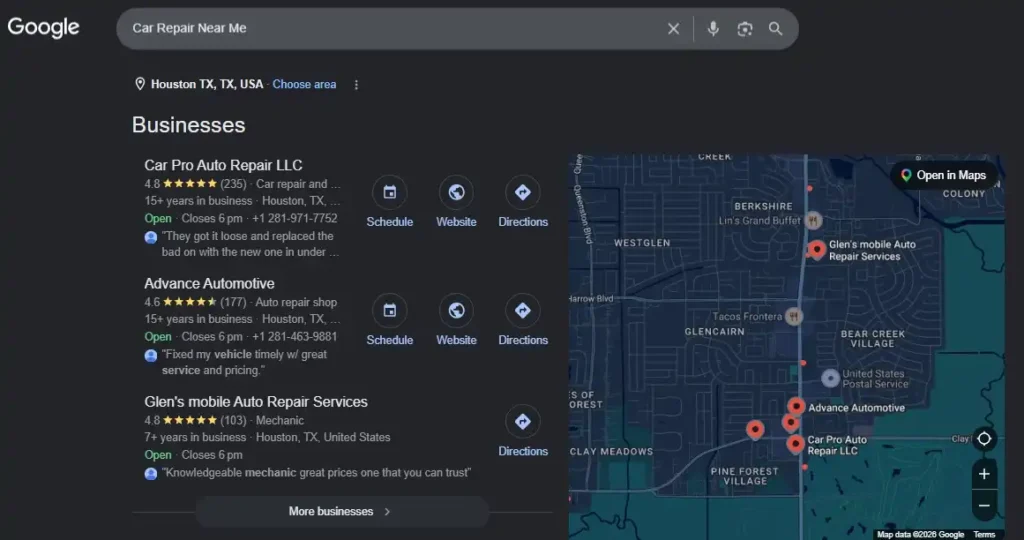
Local SEO is a specialized branch of SEO that focuses on making your business visible to people searching for products or services in a specific geographic area. If someone is looking for a plumber in Houston, a dentist in Katy, or a bakery in Austin, local SEO is what puts your business in front of them.
Here is the key distinction. Local SEO is not just about your website. It is equally, if not more, about your presence across Google Maps, the Google Local Pack, online directories, and customer review platforms. Your digital footprint needs to exist in multiple places, all consistently pointing Google to the same trustworthy information about your business.
According to Google, 46% of all searches have local intent. That means nearly half of everything people search for is connected to finding something nearby. And according to HubSpot, 88% of consumers who do a local search on their smartphone visit or call a business within 24 hours. That is an incredibly high buying intent signal.
What Does Local SEO Actually Involve?
Local SEO builds on the foundation of traditional SEO and layers in several additional tactics that are unique to local search marketing.
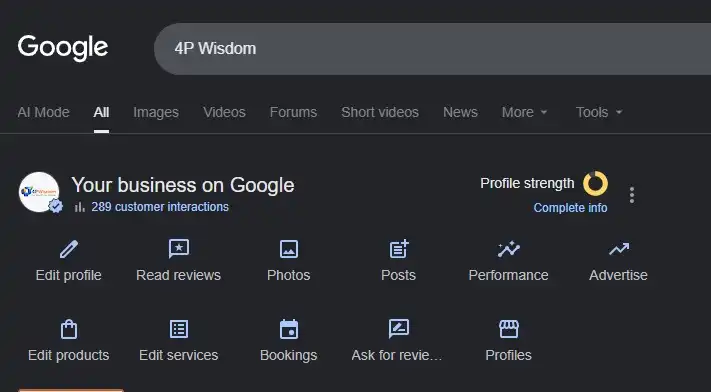
Google Business Profile (GBP) Optimization is the single most important element of local SEO. Your GBP is your free listing on Google that appears in Maps and Search. A fully optimized profile includes your accurate business name, address, and phone number (known as NAP), business category, service descriptions, opening hours, photos, and regular posts. Our team at 4P Wisdom specializes in Google Business Profile optimization that turns your listing into a constant stream of new inquiries.
Local Citation Building means getting your business listed accurately on local directories and data aggregators. Directories like Yelp, Yellow Pages, Foursquare, Justdial, and local chamber of commerce sites all contribute to your local authority. The consistency of your NAP information across all of these platforms is critical. Even small inconsistencies like an old phone number or a slightly different address format can negatively impact your local rankings.
Review Management is both a ranking factor and a conversion tool. Google uses the volume, recency, and sentiment of your reviews as a signal of trust and authority. Businesses with strong review profiles consistently outrank competitors with weaker ones. Responding to every review, positive or negative, also signals to Google that your business is active and engaged with its customers.
Location-Specific Landing Pages involve creating dedicated web pages for each city or neighborhood you serve. These pages are optimized for geo-modified keywords and help Google understand exactly which areas your business is relevant for. A pest control company serving five cities, for example, should have a separate, unique landing page for each one.
Local Link Building means earning backlinks from other businesses, organizations, and publications within your community. A sponsorship of a local sports team, a feature in a local news outlet, or a collaboration with a neighboring business can all generate powerful local backlinks that boost your Google Maps rankings.
Local Business Schema Markup is code added to your website that helps Google understand your business information in a structured way. It includes your business type, address, hours, phone number, and more. Google uses this data to better understand your relevance for local searches.
Our local SEO services cover every one of these tactics, fully managed and results-driven.
What Keywords Does Local SEO Target?
Local SEO targets geo-modified keywords and implicitly local search phrases. Examples include:
“dentist in Houston” “best restaurant near me” “electrician open now Austin” “SEO agency Katy” “plumber near Bear Creek.”
But here is something many people miss. Google does not always need you to include a city name for local intent to activate. If you search “plumber” from your phone, Google knows your location and will automatically show you local results. This is called implicit local search. Businesses that optimize for local SEO benefit from both explicit (city name included) and implicit (location-aware) searches.
Local SEO vs Traditional SEO: The Core Differences Explained
Now let us put them head-to-head in a clear, structured comparison.
| Factor | Traditional SEO | Local SEO |
| Target Audience | National or global audience | City, neighborhood, or region-specific audience |
| Primary Goal | Rank for broad, topical keywords | Rank in local search results and Google Maps |
| Search Results Location | Standard organic search results (blue links) | Google Local Pack, Google Maps, and local organic results |
| Keyword Type | Non-location-specific, informational keywords | Geo-modified keywords and “near me” searches |
| Key Ranking Factors | Content quality, backlinks, and technical SEO | Proximity, Google Business Profile signals, reviews, and local citations |
| Google Feature Used | Standard SERPs (Search Engine Results Pages) | Google Maps, Local Pack, and Local Finder |
| Business Type | e-commerce, SaaS, national service providers | Restaurants, clinics, retail stores, and local service businesses |
| Competition Scope | National or international competitors | Businesses within the same local area |
| Conversion Speed | Often slower; users may be in research mode | Faster; users typically have higher purchase intent |
| Google Business Profile (GBP) | Not required | Absolutely essential |
| Customer Reviews | Helpful but not a primary ranking factor | Critical for rankings and conversions |
| Citation Management | Generally not applicable | Highly important for local rankings |
| Time to Results | Typically 6–12 months | Often, 3–6 months for local visibility improvements |
The Single Biggest Difference
If you take nothing else from this guide, remember this. The core difference between local SEO and traditional SEO comes down to who you are trying to reach and where they are when they search.
Traditional SEO says: find me no matter where you are, as long as you care about this topic.
Local SEO says: find me because you are right here, and I am exactly what you need nearby.
How Google’s Algorithm Treats Local vs Traditional Search Differently
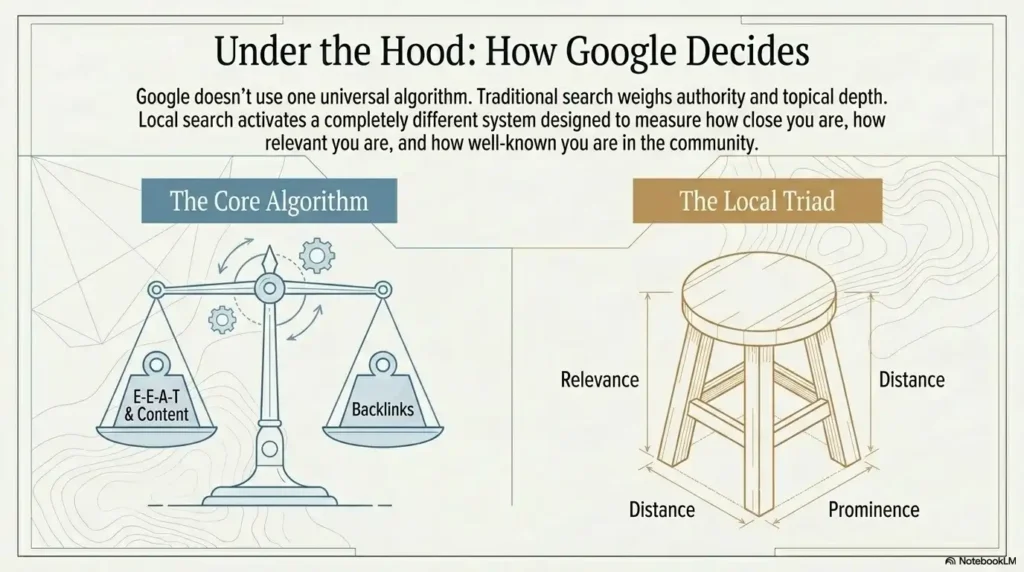
Google does not use one universal algorithm for all searches. It uses different ranking systems depending on the intent it detects behind a query.
How Google Ranks Traditional Organic Search Results
For traditional SEO, Google primarily uses its core ranking algorithm. This evaluates:
Page Authority: How many high-quality websites link to your page? Domain Authority: How trusted and established is your overall website? Content Quality: Does your content demonstrate E-E-A-T? E-E-A-T stands for Experience, Expertise, Authoritativeness, and Trustworthiness. Google introduced this framework to ensure the content that ranks is genuinely written by or reflects real expertise. Relevance: Does your content match what the searcher actually wants? Technical Health: Is your website fast, mobile-friendly, and crawlable? User Behavior: Are people clicking your result? Are they staying on the page? Are they bouncing back to Google immediately?
How Google Ranks Local Search Results
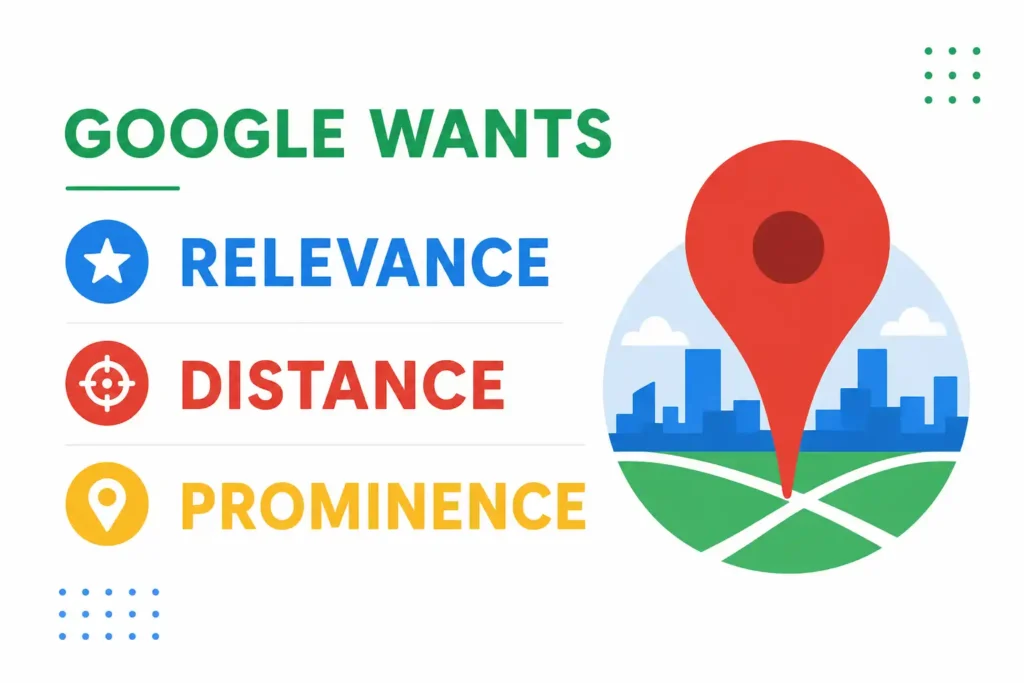
For Local SEO, Google’s local ranking algorithm relies on three core factors that differ significantly from traditional organic search rankings. Google determines relevance, distance, and prominence when deciding which businesses appear in local search results and Google Maps.
Relevance asks: Does this business match what the person searched for? Is your Google Business Profile category correct? Does your website and GBP content clearly describe your services?
Distance asks: How close is this business to the searcher? If someone searches “dentist near me,” Google will almost always prioritize dentists within a short distance, unless the other ranking factors are overwhelmingly strong for a more distant competitor.
Prominence asks: How well-known and trusted is this business, both online and offline? This includes the number and quality of your Google reviews, the strength of backlinks to your website, how often your business name appears across the web, and how complete and active your Google Business Profile is.
The Google Local Pack Explained
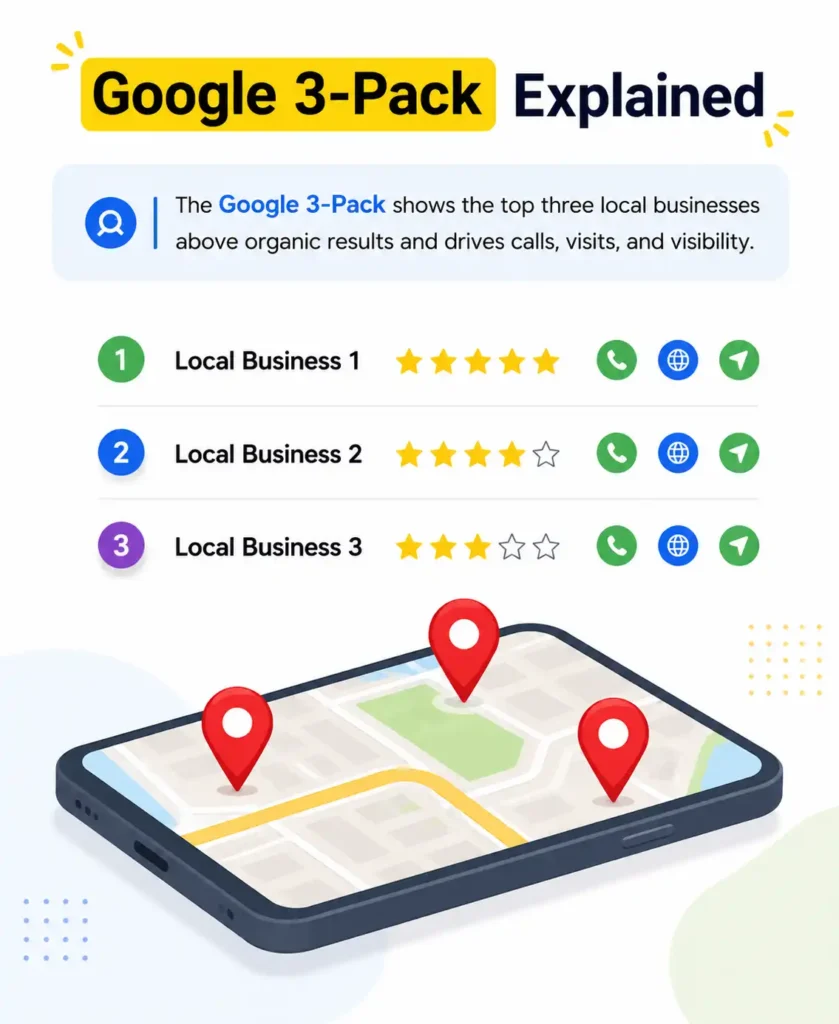
The Google Local Pack (sometimes called the Map Pack or the 3-Pack) is the section at the top of Google’s search results that shows a map and three business listings. It appears for searches with local intent.
Appearing in the Local Pack is extraordinarily valuable for local businesses. Studies consistently show that the Local Pack receives between 40% and 60% of all clicks for local searches. Being in the top 3 local results is the equivalent of having a giant billboard at the busiest intersection in your city. Businesses ranked in the Local Pack see dramatically higher phone calls, website visits, and foot traffic compared to those that only appear in the regular organic results.
This is why local SEO services that specifically target Local Pack rankings are so strategically valuable for brick-and-mortar businesses and service-area businesses alike.
Key Ranking Factors: A Detailed Breakdown for Both Types
Top Traditional SEO Ranking Factors
Content Depth and Quality: Google rewards content that thoroughly covers a topic. Long-form content that answers the searcher’s question completely, addresses related subtopics, and provides genuine value consistently outperforms thin, surface-level content.
Backlink Profile: Links from authoritative, relevant websites are one of the strongest traditional SEO signals. A single link from a respected industry publication can be worth more than a hundred links from low-quality sites.
E-E-A-T Signals: Google wants to know that the person or organization behind the content has real-world experience and demonstrated expertise. Author bio pages, credentials, company history, and mentions in respected publications all strengthen your E-E-A-T profile.
Core Web Vitals: Google officially uses page experience signals, including Largest Contentful Paint (LCP), Cumulative Layout Shift (CLS), and Interaction to Next Paint (INP) as ranking factors. These measure how fast and stable your website feels to users.
Keyword Optimization: Naturally incorporating your target keyword and semantically related terms throughout your content signals topical relevance to Google. This is not about keyword stuffing. It is about covering a topic completely and naturally.
Mobile Friendliness: Google indexes the mobile version of your website first. If your site does not work well on smartphones, your rankings across all search types will suffer.
Top Local SEO Ranking Factors
Google Business Profile Completeness: A fully completed GBP with accurate categories, services, photos, descriptions, and regular posting activity significantly outperforms an incomplete or neglected listing. Read our complete guide on the Google Business Profile optimization checklist.
Review Quantity and Quality: Businesses with more reviews, higher average star ratings, and consistent review recency rank better in local search. According to Whitespark’s Local Search Ranking Factors report, review signals account for a significant portion of local pack ranking ability.
NAP Consistency: Your Name, Address, and Phone number must be identical everywhere it appears online. Your website, your GBP, and every directory listing should all show exactly the same information. Inconsistencies create confusion for Google and damage your local authority.
Local Citations: How many reputable local directories and data aggregators list your business? The more accurate mentions of your business across trusted local sites, the stronger your local authority becomes.
Local Backlinks: Links from other businesses, news sites, and organizations within your city or region are particularly powerful for local SEO. They signal to Google that your business is a legitimate, recognized part of the local community.
On-Page Local Signals: Your website should include location-specific content. Your city name should appear naturally in your page titles, headings, body copy, and meta descriptions. Embedding a Google Map on your contact page and using LocalBusiness schema markup also strengthens these signals.
Behavioral Signals: Google tracks user behavior on your local listing. Businesses that receive more clicks, calls, direction requests, and photo views tend to rank higher over time. Active engagement with your listing is both a strategy and a signal.
Local SEO vs Traditional SEO: Which Businesses Need Which?
Businesses That Need Traditional SEO
Traditional SEO is the primary strategy for businesses that are not dependent on serving a specific geographic area. These include:
e-commerce stores that sell products online nationally or internationally. A clothing brand selling across US, or a software company with users globally needs traditional SEO to reach their distributed audience.
SaaS (Software as a Service) companies whose product is entirely digital and accessible from anywhere. There is no physical location involved. Their customers could be in any city or country.
Online education platforms, digital course creators, and e-learning companies whose students are spread across geographies.
Content publishers, news websites, and blog-based businesses that generate revenue through advertising or affiliate marketing, targeting a wide readership on specific topics.pak
B2B companies offering services that do not require in-person meetings, such as remote consulting, software development, or virtual accounting.
National service providers who operate across an entire country without a storefront model. Airlines, insurance companies, and national retail chains with no localized search intent in their primary keywords fall into this category.
Businesses That Need Local SEO
Local SEO is essential for any business that serves customers in a defined geographic area, either at its physical location or by traveling to the customer. These include:
Restaurants, cafés, and food businesses that depend on foot traffic and local dining searches.
Medical and dental practices, including general practitioners, specialists, dentists, physiotherapists, and clinics.
Legal firms, including law offices, legal consultants, and solicitors who serve clients within a specific jurisdiction.
Home service providers include plumbers, electricians, HVAC technicians, painters, pest control companies, and cleaning services.
Real estate agencies, mortgage brokers, and property managers serving a specific city or region.
Retail stores, including boutiques, bookshops, electronics stores, and any business with a physical storefront.
Fitness studios, gyms, yoga centers, and wellness businesses that rely on people visiting their premises.
Educational institutions, including schools, tutoring centers, coaching academies, and training institutes, operate from a physical location.
Businesses That Need Both
Many businesses genuinely need both traditional SEO and local SEO working together. These include:
Multi-location businesses, such as franchise chains or companies with offices in several cities. Each location needs local SEO for its specific area, while the corporate brand builds national authority through traditional SEO.
Professional services like digital marketing agencies, accounting firms, and law firms that serve both local clients and national clients through remote work. A good example is 4P Wisdom, a digital marketing agency that serves local businesses in the United States while also building national authority in the digital marketing space.
Healthcare providers who serve patients locally but also want to rank nationally for informational health content that builds their expertise and drives referrals.
Hospitality businesses like hotels and resorts need local SEO for people searching in their city, but also traditional SEO to capture travel planners searching for destination-specific content from far away.
Practical Strategy Guide: How to Execute Each Type of SEO
Traditional SEO Strategy: Step by Step
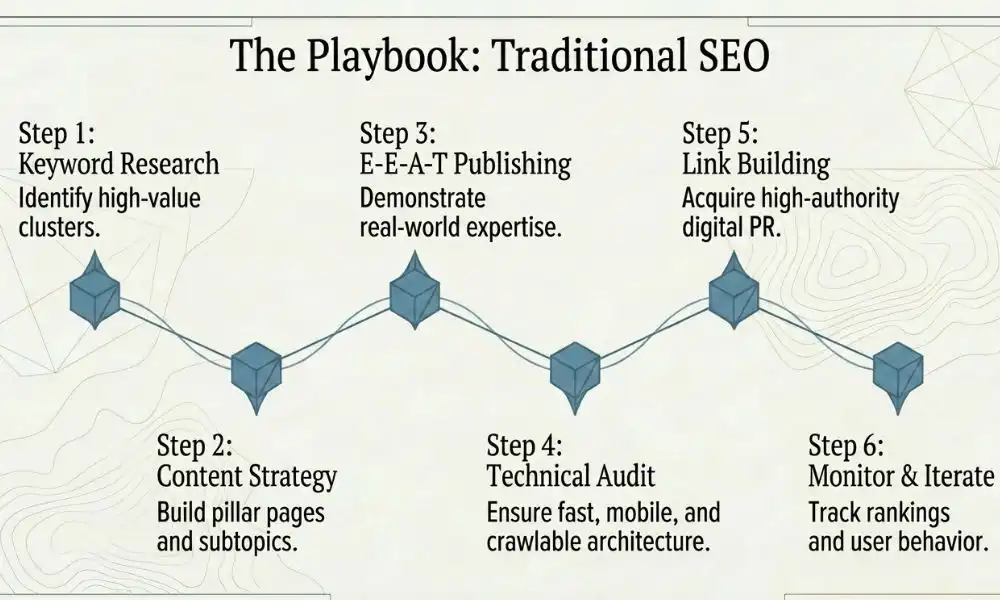
Step 1 is conducting comprehensive keyword research. Use tools like Google Keyword Planner, Ahrefs, or SEMrush to identify keywords with meaningful search volume and manageable competition. Organize your keywords into topic clusters around the main themes your business covers. Our keyword research services can do this for you with expert precision.
Step 2 is building a content strategy around those clusters. For each major topic, create a comprehensive pillar page that covers the subject in depth. Then create supporting blog posts that dive into specific subtopics and link back to the pillar page. This structure signals to Google that your site is a comprehensive authority on that topic.
Step 3 is publishing expert-level content that satisfies E-E-A-T requirements. Include author bios that establish credentials, cite data from reputable sources, and cover topics with the kind of depth that only someone with genuine expertise could achieve. Our content marketing services are specifically designed to build this kind of authority.
Step 4 is conducting a full technical SEO audit. Check for crawl errors, fix broken links, improve page loading speed, ensure your site is mobile-optimized, implement schema markup, and verify your Core Web Vitals scores through Google Search Console.
Step 5 is building high-quality backlinks through outreach, guest posting, digital PR, and creating genuinely link-worthy resources. Quality matters far more than quantity here.
Step 6 is monitoring and iterating. Track your keyword rankings, organic traffic, and conversion rates. Use Google Search Console and Google Analytics to understand what is working and where to improve.
Local SEO Strategy: Step by Step
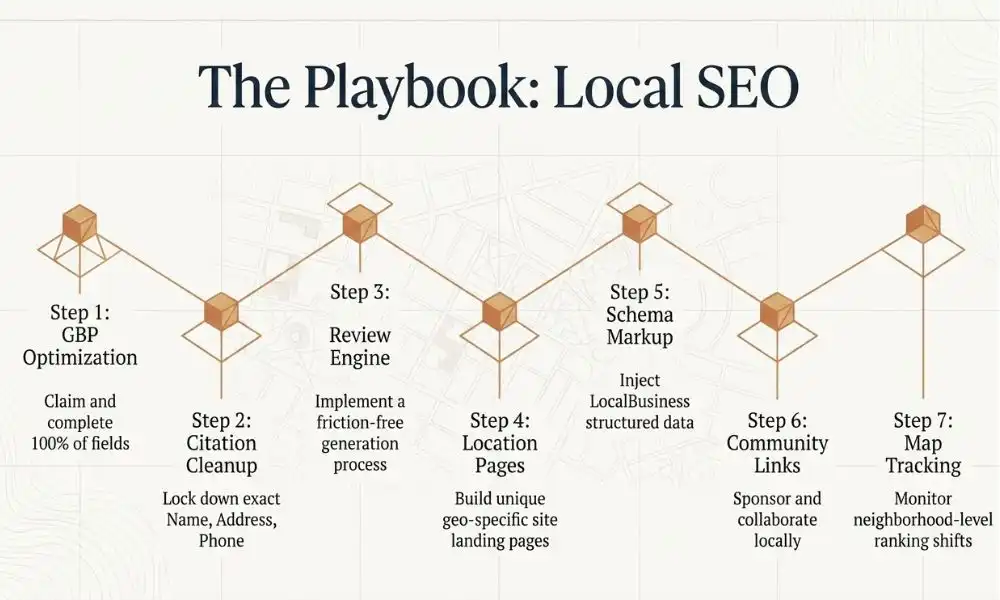
Step 1 is claiming and fully optimizing your Google Business Profile. This is not optional. Fill in every single field available. Choose the most accurate primary and secondary categories. Write a keyword-rich business description. Upload high-quality photos of your premises, team, and products. Set your exact service area. Enable messaging. Post updates regularly. Our Google Business Profile optimization service handles all of this for you.
Step 2 is building and cleaning up your local citations. Start with the major data aggregators. Then build listings on industry-specific directories and locally relevant sites. Audit all existing citations to ensure your NAP is consistent everywhere. Correct any discrepancies immediately.
Step 3 is actively generating and managing reviews. Create a simple, friction-free process for asking satisfied customers to leave a Google review. Send follow-up emails, add a review link to receipts, or use a QR code at your front desk. Respond to every single review to show you value customer feedback.
Step 4 is creating location-specific pages on your website. Each city or service area you cover should have its own unique landing page. These pages should be genuinely helpful, not just thin pages stuffed with a city name. Include local testimonials, area-specific information, and locally relevant content.
Step 5 is implementing LocalBusiness schema markup on your website. This structured data helps Google understand your business information directly from your code. It is a technical step, but it makes a meaningful difference in how Google reads and presents your business.
Step 6 is building local community connections that generate organic mentions and links. Sponsor local events, collaborate with neighboring businesses, appear in local press, and participate in community organizations. Real-world presence translates into digital authority.
Step 7 is monitoring your local rankings across Google Maps and organic search. Track how you rank for your key local terms across different neighborhoods. Monitor your review velocity and respond proactively to any negative reviews.
Mistakes That Limit Success in Both Traditional and Local SEO
Traditional SEO Mistakes to Avoid
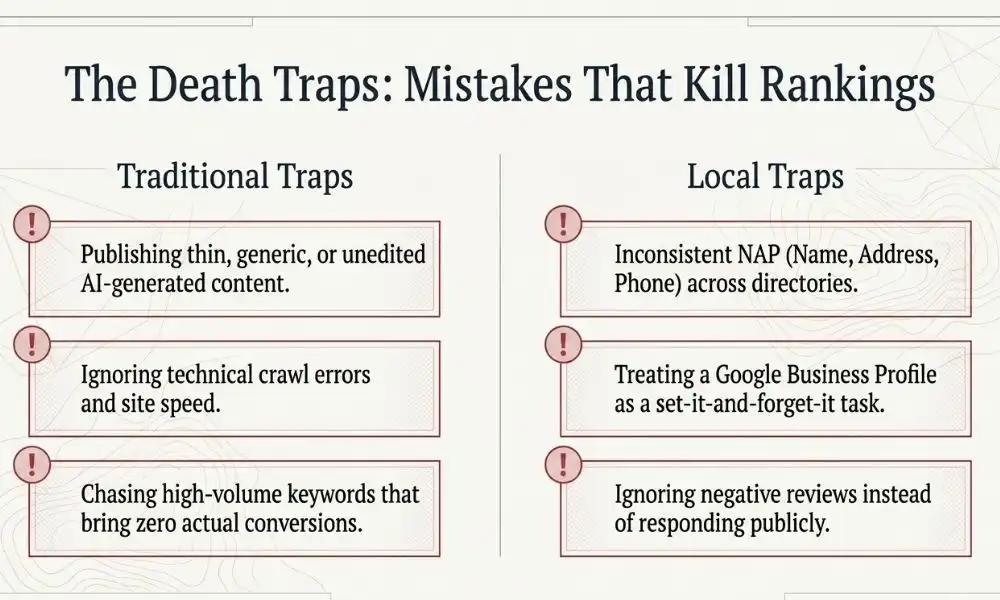
Creating thin, superficial content that barely scratches the surface of a topic. Google’s Helpful Content system increasingly filters out content that feels generic or AI-generated without genuine expertise behind it.
Ignoring technical SEO issues. A slow website with crawl errors and broken links will hold back even the best content from ranking.
Chasing the wrong keywords. Ranking for keywords that bring lots of traffic but no conversions is a waste of time and resources. Always align keyword targets with business goals.
Neglecting internal linking. Many websites have fantastic content that Google can barely find because no internal links are pointing to it from other pages. A strong internal linking structure distributes authority across your site.
Building low-quality backlinks. Links from spammy, irrelevant, or low-authority sites can actually harm your rankings. Quantity without quality is harmful, not helpful.
Local SEO Mistakes to Avoid
Leaving your Google Business Profile incomplete or inactive. An incomplete GBP with no photos, no posts, and an inaccurate category is a major missed opportunity. Google deprioritizes listings that appear neglected.
Having inconsistent NAP information across the web. If your phone number on your website is different from the one on your GBP or Yelp listing, Google gets confused. Confused search engines do not reward you with high rankings.
Ignoring negative reviews instead of responding to them. How you handle a bad review tells potential customers and Google whether your business is trustworthy and professional.
Not creating location-specific pages. One generic “About Us” page will not help you rank in multiple cities. Each area you serve needs its own optimized page.
Treating local SEO as a one-time task. Local SEO requires ongoing attention. New competitors enter the market. Reviews need responses. Your GBP needs regular posts. Algorithms change. Consistent effort beats a one-time setup every time.
Local SEO and Traditional SEO in the Era of AI Search
The search landscape in 2026 is being dramatically reshaped by artificial intelligence. Google’s AI Overviews (formerly called Search Generative Experience) now appear at the top of many search results pages, summarizing answers before users even see traditional links. Understanding how this affects both types of SEO is now essential.
How AI Search Affects Traditional SEO
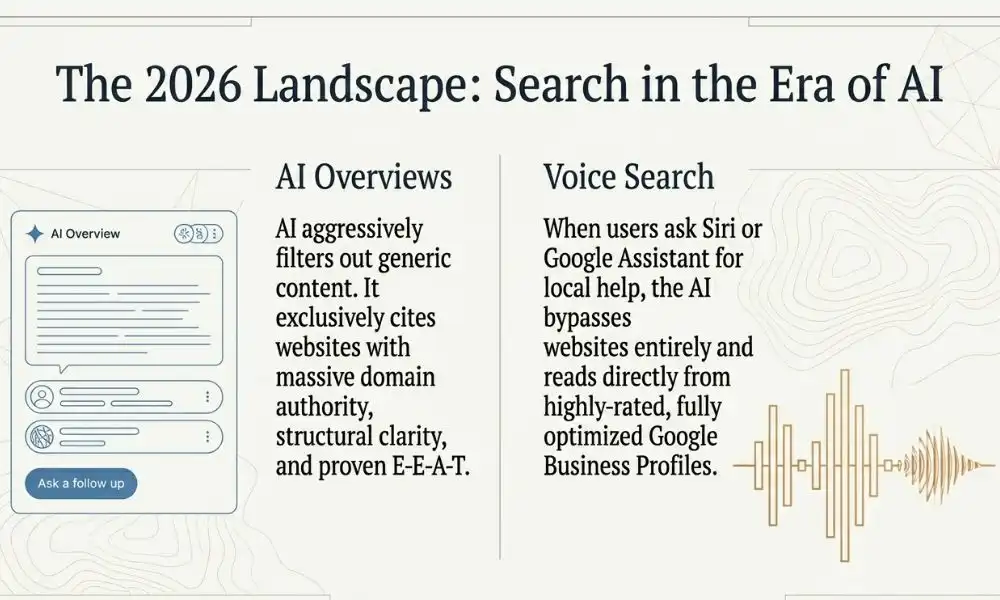
AI Overviews pull content from trusted, authoritative sources to generate their summaries. Websites with strong E-E-A-T signals, comprehensive content, and high domain authority are the ones most likely to be cited within these AI-generated answers.
The implication for traditional SEO is clear. Creating genuinely authoritative, in-depth content is more important than ever. Thin, generic content is being filtered out more aggressively. Structured content with clear headings, tables, definitions, and direct answers to specific questions is more likely to be surfaced by AI systems.
Additionally, featured snippets, which are a form of traditional SEO success, remain important as they are often the source material for AI summary boxes.
How AI Search Affects Local SEO
Voice search, powered by AI assistants like Google Assistant and Siri, has made local search even more conversational. People ask their phones things like “find a highly rated electrician near me who can come today.” Businesses with complete, accurate Google Business Profiles, strong review profiles, and clear service information are the ones appearing in these AI-powered voice responses.
Google is also integrating more local business information directly into AI Overviews for searches with local intent. Your GBP data, reviews, and website content are all feeding into what Google’s AI says about your business when someone asks about services in your area.
Read our detailed guide on how to rank in Google’s AI Overviews.
The lesson here is consistent across both types: build real authority, serve real people, and create real content. AI rewards authenticity. It has no patience for manipulation.
Final Thoughts
The difference between local SEO and traditional SEO is ultimately a question of audience and geography. Traditional SEO casts a wide net across a broad topic for anyone, anywhere. Local SEO casts a precise net within a specific area for people ready to buy right now.
Neither strategy is better than the other in isolation. The smartest businesses use both. They build a rock-solid traditional SEO foundation through great content and technical excellence, then layer local SEO on top to dominate their city or region.
If you have been asking yourself why your competitor keeps showing up ahead of you in Google Maps, the answer is almost certainly local SEO. If you have been wondering why your blog content is not driving traffic or leads, the answer is likely gaps in your traditional SEO strategy.
Both problems are completely solvable. Both solutions are available to you right now.
Ready to stop guessing and start ranking? Explore our complete SEO services at 4P Wisdom and let us build a strategy that makes your business the one customers find first, every time.
Frequently Asked Questions About Local SEO vs Traditional SEO
Is local SEO harder than traditional SEO?
Both have their own complexity. Traditional SEO is difficult because you are competing against the entire world for your keywords. Local SEO is simpler in terms of competition radius, since you are only competing with businesses in your area, but it requires managing an additional set of tactics like Google Business Profile optimization, reviews, and citations on top of your regular SEO work. For multi-location businesses, local SEO can become enormously complex at scale.
Does a local business still need traditional SEO?
Absolutely yes. There is technically no local SEO without the foundation of traditional SEO. When you create location pages, earn backlinks, and build a strong website, you are doing traditional SEO tasks that also support your local rankings. The two strategies are deeply interconnected. A business with a strong traditional SEO foundation will almost always outperform a competitor that has only done the local-specific elements.
Can traditional SEO replace local SEO for a local business?
No. If your business serves customers in a specific area and you want to appear in Google Maps and the Local Pack, you must do local SEO. No amount of traditional organic rankings can put you in the map results. The Local Pack is governed entirely by Google’s local algorithm, and only businesses that have optimized their local presence can compete for those positions.
How long does it take to see results from local SEO?
Most businesses begin to see meaningful improvements within 3 to 6 months of consistent, well-executed local SEO work. Quick wins can come earlier from tasks like optimizing your Google Business Profile and cleaning up citation inconsistencies. Some highly competitive local markets may take 6 to 12 months to see significant Local Pack ranking improvements.
What is a local citation, and why does it matter?
A local citation is any online mention of your business’s name, address, and phone number. Citations appear in business directories, review platforms, social media profiles, local news sites, and industry-specific listings. The more consistently and widely your business is cited across trusted platforms, the more authority and trust Google assigns to your local presence. Citations are one of the core building blocks of local SEO.
What is the difference between the Google Local Pack and organic results?
The Google Local Pack is the map section with three business listings that appears at the top of search results for local queries. It is governed by Google’s local algorithm and factors in proximity, GBP optimization, and reviews. The organic results are the traditional blue links below the map. These are governed by Google’s core ranking algorithm. A business can theoretically appear in both, and doing so creates a dominant presence on the results page.